Recent Federal and State Laws Lead to Drop in Medicaid Enrollments and Destabilize Texas’ Healthcare System
In 2020, health care spending in Texas reached nearly $250 billion for Texans receiving health care services, including visits with primary care doctors, medications, mental health counseling, and emergency room visits. Spending for 2020 was lower than estimated because of pandemic-era lockdowns, so in 2026, it’s likely that healthcare spending in our state will reach $300 or even $350 billion. State and federal tax dollars for Texas’ Medicaid program fund about one-fifth of that estimate, which changes based on how many people go to the hospital, what treatments they get there, how many people get diagnosed with heart disease and other conditions, how many people have health insurance, and other factors.
Healthcare statistics data reported by the Texas Health and Human Services Commission (HHSC) show that from July 2025 to July 2026, Texas’ Medicaid program lost 281,709 enrollees. In July 2025, 4,047,740 Texans were enrolled in Medicaid, and in July 2026, 3,766,031 Texans were enrolled.
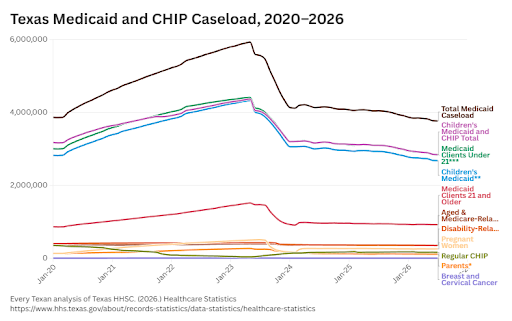
The interactive graph is available at this link.
Since the 2026 Federal Poverty Level (FPL) guidelines, which set baselines for Medicaid eligibility determinations, increased by 2.63% from 2025–2026, slight increases in Texans’ weekly wages in the first quarter of 2026 do not account for 281,709 Texans becoming ineligible for Medicaid. That is to say, many of the 281,709 Texans (256,842 of whom are children under 19) did not lose Medicaid because their families’ incomes increased. They lost Medicaid because of red tape and paperwork, inaccurate decisions about their eligibility, and miscommunications coming from HHSC or its vendors with whom HHSC contracts to answer client phone calls and questions. Most of the 281,709 Texans who are no longer enrolled in Medicaid are still eligible, and their working family members continue to pay taxes that fund the program. However, those newly-uninsured Texans and their families are now more likely to develop more expensive medical conditions with less favorable outcomes since they will lack preventive and primary care to treat conditions in early stages. They are also more likely to face medical debt and lower wages over time.
With about 20% of Texas healthcare spending coming from Medicaid funds, shifts in Medicaid enrollment make significant impacts on the state’s mix of payers (primarily made of insurance companies, employers, and publicly-funded programs) who fund the $300+ billion price tag for Texans’ health care. With average annual Medicaid spending per child enrollee at $5,013 in 2024, our state’s enrollment barriers and miscommunications are causing the state healthcare system to lose out on $1.3 billion per year for those 256,842 newly-uninsured children. For the 10,082 Texans who are no longer enrolled in Medicaid for people with disabilities, our state’s enrollment barriers and miscommunications are causing the state healthcare system to lose out on an additional $245 million per year if those Texans remain disenrolled.
Reductions in state healthcare funding just for those children and Texans with disabilities who recently lost Medicaid eclipse the total $1.4 billion the federal government awarded to Texas over the course of five years as part of H.R. 1’s Rural Health Transformation Fund. H.R. 1’s mandate for states to implement SNAP work requirements in part caused many of the red tape and paperwork issues that are leading to the recent declines in Medicaid, a nearly 20% drop in SNAP enrollment, and huge increases in HHSC’s backlog of unprocessed applications. These disenrollments—which, again, are affecting mostly children and people who remain eligible for Medicaid—are part of the design of that law. Congressional lawmakers knew that these barriers to access for Texans vulnerable to lacking health care coverage and these funding crises would come to pass as a result of H.R. 1.
Everyone seeking health care in Texas will see higher costs as a result of these Medicaid disenrollments as newly-uninsured people seek care at hospitals instead of the doctors they regularly see. Without long-term investment from state and federal lawmakers, hospitals around the state—potentially 21 hospitals in rural parts of Texas—will close, and healthcare workers will lose their jobs. Between job losses due to H.R. 1’s cuts to Medicaid and SNAP and job losses due to Congress’ failure to extend Marketplace health insurance subsidies at the end of 2025, Texas healthcare and food workers (nurses, clinicians, grocery store employees, and others) stand to lose 117,500 jobs.
As we approach Texas’ 90th Legislative Session, Every Texan and Cover Texas Now partners call on lawmakers to correct the recent disenrollments, improve health and reduce health care costs for all Texans, and make those long-term investments in the Texans’ health and our healthcare system by:
Funding HHSC’s Legislative Appropriations Request to make permanent the positions of 642 temporary Access and Eligibility Services staffmembers;
Funding HHSC-certified Community Partner Programs whose staff help Texans apply for Medicaid, CHIP, and SNAP and get through the red tape;
Improving application review and determination processes, accuracy, and efficiency by increasing state utilization of reliable data sources to verify eligibility criteria like income, employment status, address, etc.;
Protecting Texans from junk insurance and alternative health plans that leave enrollees with gaps in coverage, high deductibles, or overly complex paperwork requirements for seeing doctors and getting medications; and
Closing the health insurance coverage gap for low-income adults and bringing billions of federal dollars into the Texas healthcare system by removing the age limit for income-based Medicaid eligibility.
Cover Texas Now welcomes partners in working together to strengthen Texas’ healthcare systems and assure equitable health outcomes across our state. Our coalition meets on the fourth Thursday of each month at 3pm.
For follow-up, contact Lynn Cowles, Director of Health and Food Justice at Every Texan, 512-522-3220 / [email protected]